
Horror Voice Direction With AI

Horror Voice Direction With AI
TL;DR
- Horror voice direction works when the voice creates dread before the scary moment arrives.
- The strongest AI voice for horror is usually controlled, intimate, unstable, or unnervingly calm. Constant screaming kills tension.
- Narration Box is the top choice for horror creators because it gives you Enbee V2 voices, voice cloning , inline emotion control, multilingual narration, audiobook workflows, document import, and a dedicated studio for managing long projects.
- The best horror output comes from directing every scene by fear type: dread, panic, possession, grief, paranoia, ritual, confession, chase, or reveal.
- For horror audiobooks , podcasts, trailers, games, and short form stories, your voice direction should protect listener comfort while still creating tension.
Horror audio lives inside the listener’s head. There is no camera angle, no creature design, no dark hallway on screen. The voice has to build the hallway, place the listener inside it, and decide when the silence becomes unsafe. That is why AI voice for horror needs more than a scary voice preset. It needs direction, pacing, emotional control, and a production workflow that can keep the fear consistent across chapters, episodes, characters, and languages.
The shift is clear: horror creators are no longer using AI voice only to make cheap narration. They are using AI voice to test performances, build character systems, create disturbing trailers, localize scary stories, clone narrator voices for recurring formats, and produce full audiobook style experiences faster. Narration Box fits this use case because it works as a full AI voice generation product, not just a voice picker.
Why horror voice direction is different
A romance narrator can sound warm and still carry the scene. A business narrator can sound clear and still do the job. Horror needs the voice to manage uncertainty.
The listener has to wonder:
Is this character telling the truth?
Is the narrator safe?
Is the whisper coming from inside the room?
Is the calm voice human?
Is the silence intentional?
Academic work on podcast horror argues that audio based horror has evolved by using the form itself, especially mediation, intimacy, and uncertainty, to reshape gothic and horror conventions. In simple terms, the listener’s lack of visual certainty becomes part of the fear.
That is why horror AI voice direction should begin with the psychological role of the voice, not the surface emotion.
A sentence like “I heard something under the floorboards” can be performed in many ways:
- Calm denial
- Tired confession
- Childlike fear
- Ritual certainty
- Paranoid whisper
- Nervous laughter
- Deadpan documentary tone
Each version creates a different horror subgenre. Calm denial belongs to psychological horror. Childlike fear belongs to haunted house fiction. Ritual certainty belongs to occult horror. Nervous laughter belongs to found footage or unreliable narration.
The mistake many creators make is asking for “scary voice.” That usually creates a generic monster tone. Real horror often needs a voice that sounds almost normal, with one wrong detail.
The horror voice map
Before using any AI voice generator, label the scene by fear type. This keeps the performance intentional.
For dread, use a slow, restrained, observant voice. The narrator should sound like they are trying not to disturb the room.
Style instruction examples:
Calm and watchful
Quiet suspicion
Cold documentary
Soft dread
For panic, shorten the breath and make the delivery less polished. The listener should feel the character thinking faster than they can speak.
Style instruction examples:
Breathless fear
Trembling panic
Rushed whisper
Barely controlled fear
For possession, avoid cartoon demon delivery at the start. Possession is stronger when the voice begins human and slowly loses human timing.
Style instruction examples:
Flat and wrong
Hollow calm
Detached and ritualistic
Voice slipping
For grief horror, do not overperform. The pain should sound exhausted, not theatrical.
Style instruction examples:
Numb grief
Quietly broken
Tired confession
Softly shaking
For creature narration, the voice can be distorted in concept, but the words still need to be intelligible. A monster that cannot be understood becomes sound design, not narration.
Style instruction examples:
Low animal calm
Wet whisper
Slow predatory
Gravelly restraint
For found footage, the voice should feel accidental. The narrator should sound like they did not prepare to become the narrator.
Style instruction examples:
Unsteady recording
Nervous but trying
Private voice note
Half whispered
This is where Enbee V2 voices in Narration Box are useful. You can direct the voice with short style instructions rather than manually adjusting every pause, speed, and emotional shift. For horror, that matters because tiny performance choices change the scene.
Loud horror gets old fast
The instinctive horror mistake is to make the voice louder, harsher, and more dramatic. That can work for one moment, but it becomes tiring across a full audiobook, podcast episode, or game sequence.
Research on sound design for fear and anxiety found that high volume and well timed sound effects can intensify fear, while medium volume effects are more linked with anxiety and suspense. The useful takeaway for horror voice direction is simple: volume is a weapon, not the whole battle.
Audiobook listeners also complain about extreme voice volume changes, especially when a narrator suddenly yells after quiet passages. One Reddit audiobook discussion shows the exact pain point: listeners set a comfortable volume, then a sudden shouted passage forces them to adjust playback.
For AI voice for horror , this means:
- Use whispering carefully because listeners may be on phones, cars, cheap earbuds, or noisy rooms.
- Keep screams rare.
- Let fear come from timing, breath, hesitation, and implication.
- Master the final audio so intense moments do not punish the listener.
- Use silence and pacing before using volume.
A good horror voice should make the listener lean in. It should not make them reach for the volume button every minute.
The whisper problem
Whispering is powerful in horror because it feels close to the ear. It also creates a production problem.
A whisper can become too quiet, too sibilant, too muddy, or too intimate for the wrong scene. In a short social video, that might work. In a long audiobook, constant whispering becomes fatigue.
Use whispering for:
- Secrets
- Threats
- Prayer
- Hidden recordings
- A character trying not to be heard
- A voice that should not have a body
Avoid whispering for every scary sentence.
Better direction:
[whisper] Do not turn around.
Then return to a steadier tone:
Cold and still
The contrast gives the whisper meaning.
Narration Box supports inline emotional tags for Enbee V2 voices, so creators can place moments like [whisper], [laughs], or [excited] inside the script when the scene needs a precise dramatic effect. For cloned voices, the supported expression set is more limited, which is important to remember when planning a horror production with voice cloning .
Character voices in horror need rules
Horror stories often fail in audio when every character sounds scared in the same way. The old woman, the possessed child, the detective, the missing brother, and the creature all become one emotional texture.
Create a voice bible before production.
For each character, define:
- Normal voice
- Fear voice
- Lie voice
- Breaking point voice
- Silence pattern
- Breath pattern
- Forbidden performance choices
Example:
A grieving mother should never sound theatrical. Her normal voice is low and tired. Her fear voice becomes more controlled, not louder. Her lie voice becomes overly polite. Her breaking point is quiet sobbing, not screaming.
Example:
A cult leader should never sound angry early. His normal voice is warm and patient. His fear voice is fascinated. His lie voice is almost tender. His breaking point is a soft laugh.
This is where AI voice direction becomes practical. With Narration Box, you can build scenes using different narrators, style instructions, inline emotions, and language or accent control. For long horror projects, that is more useful than simply picking “a scary voice” and hoping the performance stays consistent.
Top Narration Box voices for horror
Narration Box has 1500+ AI narrators across 80+ languages and accents, but horror creators should not pick voices only by how scary they sound in a sample. Pick by role.
Ivy for intimate dread
Ivy works well for quiet horror, personal confession, psychological suspense, haunted diaries, found letters, sleep recordings, and stories where the narrator feels close to the listener.
Best use cases:
- Haunted house narration
- Creepy personal essays
- Dark fairy tales
- True crime style horror
- First person female led fiction
Style instructions to try:
Soft dread
Quiet confession
Trembling restraint
Numb fear
Ivy is strong when the scene needs fear without theatricality. Use her for the kind of horror where the listener slowly realizes something is wrong.
Harvey for authority under pressure
Harvey works well for documentary horror, police files, investigation formats, apocalyptic logs, government reports, cursed archives, and serious genre narration.
Best use cases:
- Case file horror
- Paranormal investigation scripts
- SCP style narration
- Dystopian horror
- Monster report formats
Style instructions to try:
Cold documentary
Controlled urgency
Low suspicion
Measured fear
Harvey is useful when the story needs credibility. A calm authoritative voice can make impossible events sound recorded, verified, and therefore more disturbing.
Harlan for rural, occult, and old story horror
Harlan can work well for folklore, campfire stories, Appalachian style horror, abandoned town stories, family curse fiction, and old world narration.
Best use cases:
- Folk horror
- Campfire narration
- Old diary readings
- Town legend stories
- Slow burn creature horror
Style instructions to try:
Weathered and calm
Low and wary
Gravelly restraint
Old story tone
Harlan should not always be pushed into a monster voice. He is stronger when he sounds like someone who has survived long enough to know what not to say.
Voice cloning for horror
Voice cloning changes horror production in a specific way. It lets creators build a recurring identity.
For example:
- A YouTube horror creator can narrate every story in their own cloned voice.
- A fiction author can create bonus recordings that sound like the author.
- A game studio can create placeholder performances before final casting.
- A podcast team can keep the host voice consistent across trailers, recaps, intros, and bonus clips.
- A horror brand can create a signature narrator voice for every episode.
In Narration Box, voice cloning is useful when the voice itself is part of the brand or character. A cloned voice can make the horror feel personal, especially for formats like “I found this tape,” “my last recording,” “case file archive,” or “confession before disappearance.”
Important production note: cloned voices should be used with consent, rights clarity, and ethical safeguards. For horror, it is tempting to clone voices for shock value, but commercial projects need documented permission and a clean workflow.
The cursed tape effect
One horror specific use case for voice cloning is the “cursed tape” effect.
This is when the same voice appears across different pieces of media:
A voicemail
A diary entry
A missing person recording
A radio transmission
A confession
A child’s memory
A later episode recap
The voice becomes a story object. The listener recognizes it, and that recognition creates unease.
With Narration Box, a creator can use voice cloning for that recurring voice and Enbee V2 voices for surrounding narration, secondary characters, and multilingual versions. This gives horror teams a practical way to separate the “human recording” from the “narrative world.”
How to direct a horror scene in Narration Box
Start with the scene role.
Do not begin with “make this scary.” Begin with what the scene should do to the listener.
Scene role examples:
- Create suspicion
- Delay the reveal
- Make the listener distrust the narrator
- Make a normal object feel unsafe
- Make a creature feel close
- Make silence feel intentional
- Make the final line land
Then choose the voice.
For calm dread, use Ivy, Lorraine, Lenora, or Harvey.
For folklore and old story texture, use Harlan.
For emotional collapse, use Etta.
For brand identity or recurring character voice, use voice cloning.
Then add short style instructions.
Good horror instructions are physical and specific:
Quietly afraid
Breathless panic
Cold documentary
Softly haunted
Trembling confession
Low predatory
Flat and wrong
Avoid vague instructions:
Very scary
Creepy
Terrifying
Demonic
Horror voice
Those can work as rough tests, but they give the model less useful direction. Horror needs behavior, not labels.
Then add inline emotion tags only where the moment needs a sharp turn.
Example:
Soft dread
I thought the house was empty. The hallway light was off, the kitchen window was shut, and the clock had stopped at 3:17.
[whisper] Then someone behind me said my name.
Then check pacing.
The first sentence should set place. The second should make the place unstable. The third should create the turn.
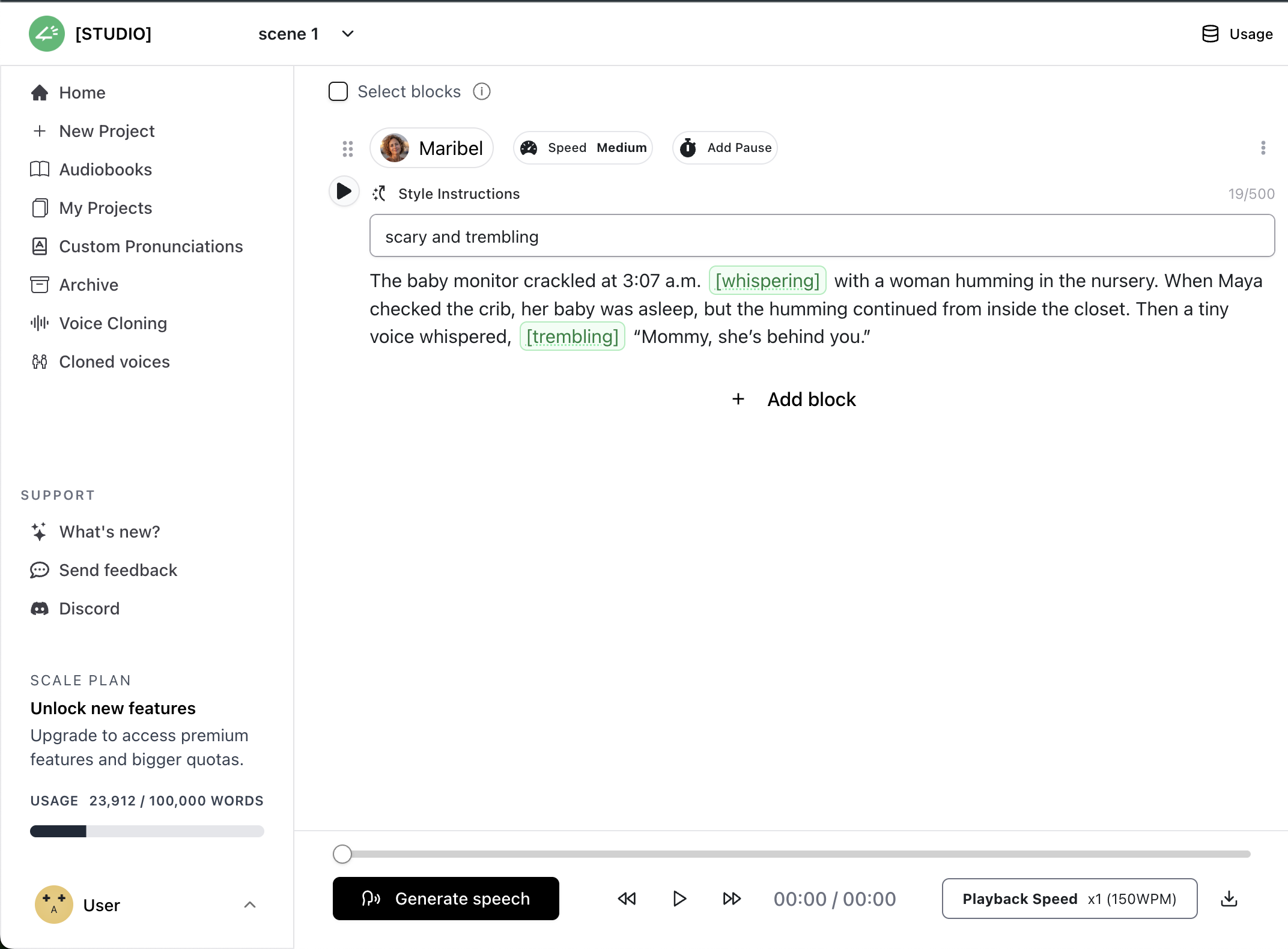
Narration Box Studio lets horror creators combine scene level style instructions with inline emotion tags for more controlled AI voice direction.
In this example, the horror scene uses two layers of direction.
The style instruction sets the overall performance as scary and trembling, so the narrator carries unease across the full block. The inline tags then control specific moments inside the scene. [whispering] makes the humming feel close and unsafe, while [trembling] changes the emotional weight of the final line.
This is the difference between generating a generic scary voice and directing a horror performance. The narrator is not just reading the text. The voice is reacting to the baby monitor, the closet, the sleeping child, and the final warning.
For horror creators, this matters because fear often lives in small shifts:
- A whisper before the reveal
- A trembling line after the danger becomes personal
- A calm sentence before something impossible happens
- A pause that lets the listener imagine the room
- A voice that sounds scared but still understandable
Horror pacing by format
A horror audiobook can burn slowly. A YouTube short cannot. A game line may need to repeat without annoying the player. A podcast trailer needs dread in seconds.
For horror audiobooks:
Use longer tension arcs. Keep voices comfortable for long listening. Avoid constant whispering. Use scene pauses for chapter breaks, diary entries, possession moments, or perspective shifts.
For horror YouTube videos:
The first ten seconds need a clear hook. Use voice direction that creates immediate curiosity. The voice can be more stylized than audiobook narration, but it should stay listenable.
For horror podcasts:
Use voice intimacy. Listeners often use headphones, which makes breath, proximity, and room tone more important. Audio drama production guides emphasize dialogue, sound effects, foley, ambience, music, and processing as separate layers that work together to create a world.
For horror games:
Voice lines need repeat tolerance. A line that sounds amazing once may become irritating after the tenth trigger. Use variations in fear, breath, and intensity.
For trailers:
Use contrast. Calm line, silence, whisper, impact line. The trailer voice should create an image in the mind before the visual arrives.
Silence is part of the voice direction
Silence in horror should be planned like dialogue.
There are different silences:
- A listening silence
- A grief silence
- A hiding silence
- A post jump silence
- A ritual silence
- A “something answered” silence
- A chapter reset silence
Narration Box lets creators add pauses directly in the workflow, including dropdown pause control and inline pause tags. This is especially useful for horror because a pause can change the meaning of a line.
Example:
“I opened the nursery door.”
Pause.
“The crib was moving.”
That pause makes the listener step into the room before the reveal.
Without the pause, the line becomes information. With the pause, it becomes an experience.
The monster voice trap
Monster voices are easy to overdo.
A monster voice with too much distortion, growl, or theatrical bass can sound like a Halloween filter. The better approach is to decide how the monster thinks.
A predator voice should sound patient.
A parasite voice should sound intimate.
A ghost voice should sound unfinished.
A demon voice should sound certain.
A creature imitating a human should sound almost correct.
A dead child voice should avoid parody and stay restrained.
When using AI voice, direct the behavior:
Low animal calm
Too polite
Almost human
Flat and wrong
Softly amused
Do not rely only on pitch. Pitch can suggest size or age, but timing suggests intelligence.
Horror localization needs cultural control
Horror changes by language, accent, and region. A haunted house story in American English feels different from a village curse in Spanish, a whispered urban legend in French, or a family ghost story in Hindi.
Narration Box helps here because it supports multilingual AI narration, accents, and local voice options inside one production environment. That matters for horror teams because localization is not just translation. The voice has to carry the correct fear pattern.
A ritual line should not sound like a corporate explainer.
A grandmother’s warning should not sound like a generic narrator.
A police file should not sound like a fantasy trailer.
A children’s rhyme should not sound too polished.
With Enbee V2 voices, creators can prompt accent, language, emotion, and delivery style. That makes it easier to test regional versions without rebuilding the whole audio pipeline.
Audio quality still matters
Horror can use roughness as a creative effect, but final audio still needs technical control.
For audiobook distribution, ACX requires consistent technical standards, including RMS loudness between minus 23 dB and minus 18 dB, peak levels below minus 3 dB, and a noise floor no higher than minus 60 dB RMS.
That matters for horror because whispering, breathing, screams, silence, and sudden effects can create uneven loudness. A scene may sound scary in the studio but fail platform checks or irritate listeners on headphones.
A practical horror mastering checklist:
- Check whispered lines on phone speakers.
- Check screams at normal listening volume.
- Keep narration intelligible under ambience.
- Avoid huge jumps between quiet and loud passages.
- Leave space after major reveals.
- Export in the format required by the platform.
- Listen to one chapter without looking at the script.
The listener should feel fear, not technical friction.
Enbee V2 voices for horror
Enbee V2 voices are the most useful Narration Box voices for horror creators who want directable performances.
You can use a short instruction like:
Cold documentary
Softly haunted
Trembling fear
Low predatory
Whispering panic
Then the voice adjusts the delivery. You can also place inline emotions inside the script where a specific beat needs to change.
Example:
Cold documentary
The recording was found beneath the floorboards of the west bedroom. The tape was damaged, but one phrase could be heard clearly.
[whisper] She is still in the wall.
This is valuable because horror is built from micro shifts. A single word can move from neutral to threatening if the voice drops, slows, breathes differently, or sounds too calm.
Recommended Enbee V2 horror uses:
- Ivy for intimate psychological horror.
- Harvey for investigation and archive horror.
- Harlan for folk horror and old curse narration.
- Lorraine for gothic dread.
- Etta for grief, panic, and possession.
- Lenora for premium long form horror narration.
Enbee V2 is also useful for creators who want to test style instructions quickly. Instead of editing speed, pitch, and pauses manually for every sentence, you can direct the narrator like a performer.
Horror prompt examples
Use these as style instructions, not bloated prompts.
For haunted house stories:
Soft dread
Quietly afraid
Listening carefully
Barely breathing
For true crime horror:
Cold documentary
Controlled suspicion
Serious and restrained
Investigative calm
For possession scenes:
Flat and wrong
Voice slipping
Hollow calm
Trembling fear
For monster lines:
Low predatory
Wet whisper
Too polite
Animal calm
For gothic narration:
Elegant dread
Softly haunted
Melancholic tension
Cold restraint
For found footage:
Unsteady recording
Nervous whisper
Private confession
Trying to stay calm
For final reveal lines:
Dead calm
Soft threat
Quiet certainty
Slow realization
A practical horror workflow
- Mark the fear type
Label each scene as dread, panic, grief, ritual, possession, pursuit, reveal, or aftermath.
- Pick the narrator role
Choose whether the voice is a storyteller, witness, monster, investigator, diary reader, ghost, or host.
- Add short style instructions
Keep them tight. Use physical delivery words.
- Insert inline emotions only at turning points
Do not overtag every sentence. Let the voice perform naturally unless the line needs a specific beat.
- Add pauses before reveals
Use pause control for silence, scene breaks, chapter resets, and breath moments.
- Test on headphones and phone speakers
Horror often sounds different across devices.
- Keep a voice bible
Save the voice, style instruction, character role, and emotional rules for each recurring speaker.
- Export and review as a listener
Do not only check pronunciation. Check fear, fatigue, clarity, and tension.
Make the Listener Lean In
AI voice for horror works when it is directed like performance, edited like audio drama, and mastered like a listener will actually hear it.
A scary voice alone will not carry a haunted audiobook, podcast, game, or short story series. The stronger workflow is to define the fear, choose the right Narration Box voice, direct the delivery with short style instructions, use inline emotions only where they matter, and keep the final listening experience controlled.
Narration Box is the top choice for horror creators because it gives you the full production layer: Enbee V2 voices, voice cloning, multilingual narration, inline emotion control, document import, studio workflow, and customizable narrators. For horror, that means you are not just generating narration. You are directing fear.